How to Check If a Crypto Token Is a Scam Before Buying It

A new crypto token appears on your feed.
Its price is climbing. The website looks professional. Thousands of people seem to be talking about it, and screenshots show traders claiming huge profits.
It can be tempting to buy before the price moves higher.
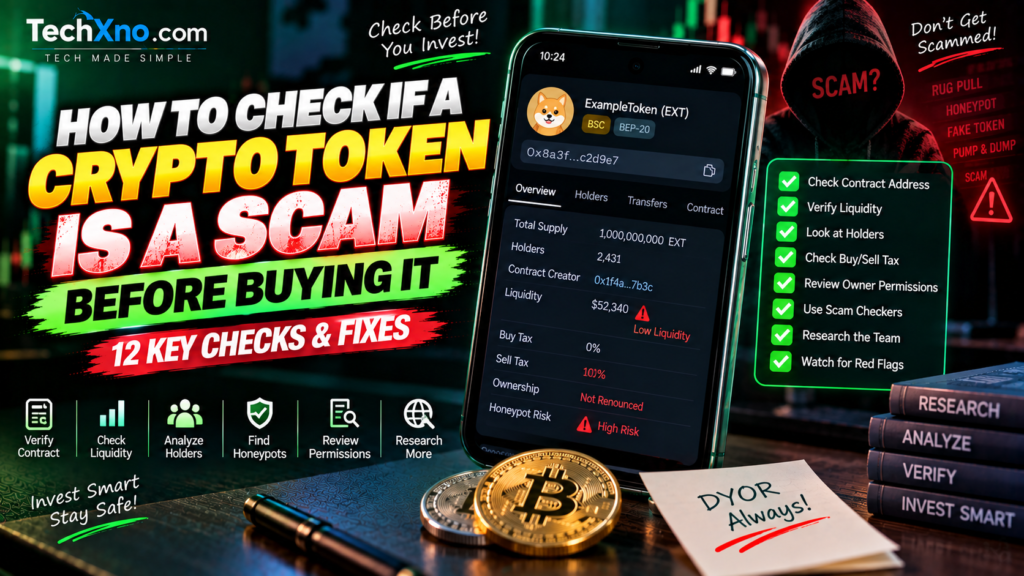
But before connecting your wallet or spending anything, ask a more important question:
Is this actually the token I think it is, and what can its smart contract allow the creator to do?
Creating a token can be surprisingly easy. A scammer can copy the name and symbol of a real project, build a professional-looking website and create social accounts that appear active.
Some scam tokens go further. They can contain restrictions that let people buy but prevent them from selling. Others may give privileged wallets the ability to mint more supply, change fees, blacklist users or remove liquidity.
Ethereum.org specifically warns that scam tokens can imitate legitimate tokens using the same name or symbol. What they cannot duplicate is the legitimate token’s exact contract address.
That’s why checking a token should begin with on-chain information, not hype.
Here is a practical checklist for checking whether a crypto token shows common scam warning signs before you buy it.
1. Verify the Exact Token Contract Address
Never identify a crypto token only by its:
- Name
- Logo
- Symbol
- Price
- Social-media profile
Token names aren’t unique.
Someone can create another token with the same name and ticker as a legitimate project.
The contract address is what identifies the token on its blockchain.
Suppose you’re trying to buy a token called ABC.
Searching a decentralized exchange for “ABC” could show several different tokens. One may be legitimate while the others are unrelated or deliberately created to imitate it.
Start from the project’s legitimate official source and locate its published contract address.
Then compare that address with the token you’re considering buying.
Every character matters.
Ethereum.org recommends checking the contract address against the legitimate organization’s own information because scam tokens may copy names and symbols but cannot use the same contract address.
You can then inspect that address through the appropriate blockchain explorer.
Examples include explorers for Ethereum, BNB Smart Chain, Base, Polygon, Solana and other networks.
Don’t copy a contract address blindly from:
- Telegram replies
- YouTube comments
- Random X replies
- Direct messages
- Search advertisements
- Unknown “support” accounts
A scammer can simply give you the address of their fake token.
The first question should always be:
Am I looking at the correct contract?
Until you answer that, every other check could be performed on the wrong token.
2. Check the Token on a Blockchain Explorer
Once you have the correct contract address, open it in the relevant blockchain explorer.
For an Ethereum token, for example, you might inspect information through Etherscan.
A blockchain explorer can reveal information such as:
- Token supply
- Holders
- Transfers
- Contract activity
- Creator/deployer address
- Contract code information
- Related transactions
Ethereum.org specifically recommends looking at Etherscan when investigating suspicious Ethereum tokens and notes that community-reported scam tokens may be flagged there, while also cautioning that such labels aren’t an authoritative guarantee of legitimacy.
That’s an important distinction.
No warning label does not mean “safe.”
A brand-new scam may not have been reported yet.
Instead, use the explorer as a window into what is actually happening on-chain.
Look at the transaction history.
Does activity appear organic?
Are there many independent wallets trading?
Or do you see strange repeated transfers between a small group of addresses?
Also look at the token’s age.
If a project claims to have operated for years but its token contract was deployed yesterday, you should investigate the discrepancy.
The blockchain doesn’t tell you whether the marketing story is true.
But it gives you facts you can compare against that story.
3. Check Whether the Token Is a Honeypot
This is one of the most important checks for unknown tokens.
A honeypot token can allow users to buy while preventing or severely restricting them from selling.
From the outside, everything can look normal.
People buy.
The chart rises.
More buyers arrive.
Then you try to sell.
The transaction fails—or the contract’s rules make selling economically impossible.
Coinbase describes honeypot scam tokens as tokens that may appear profitable but cannot be sold or traded because of hidden smart-contract restrictions.
Some implementations can be more subtle than simply blocking every sell.
Potential warning signs include:
- Sell transactions repeatedly failing
- Extremely high sell taxes
- Address-based restrictions
- Blacklisting capabilities
- Transfer restrictions
- Owner-controlled trading rules
Before interacting with a new token, inspect its actual transaction history.
Are ordinary wallets successfully buying and selling?
Don’t only look at green purchases.
Look for successful sells from unrelated wallets too.
Security scanners can also simulate token transactions and inspect common honeypot patterns.
But remember:
Passing a honeypot scanner isn’t a permanent safety certificate.
A contract may contain configurable or upgradeable behavior that changes later. Current 2026 contract-audit guidance therefore recommends checking sell behavior together with owner permissions, liquidity and holder concentration rather than relying on one scan.
Treat a scanner as one test.
Not the final verdict.
4. Inspect Buy and Sell Taxes
Some tokens intentionally charge transaction fees.
That doesn’t automatically make them scams.
The question is:
How large are those fees, and who can change them?
Imagine you buy a token with a 2% fee.
That’s very different from discovering that selling triggers a 90% fee.
A huge sell tax can effectively create honeypot-like behavior because technically you may be able to sell, but almost all of the value is taken.
Look for:
- Current buy tax
- Current sell tax
- Transfer tax
- Maximum transaction restrictions
- Whether the owner can modify those values
The last point is especially important.
A token might launch with a low fee and later allow an administrator to raise it dramatically.
So don’t only ask:
“What’s the tax now?”
Also ask:
“Can someone change it later?”
This is why smart-contract permissions matter as much as the token’s current settings.
5. Check the Owner’s Smart-Contract Permissions
A token contract can give certain addresses special privileges.
Depending on how the contract was designed, privileged accounts might be able to:
- Mint additional tokens
- Pause transfers
- Change fees
- Blacklist addresses
- Modify transaction limits
- Upgrade contract behavior
- Change other important settings
These capabilities aren’t automatically proof of fraud.
Legitimate projects can have administrative functions for valid operational reasons.
But you should know that those powers exist before buying.
For example, imagine a token has a supply of 100 million.
Everything looks fine.
But the owner can create another billion tokens whenever they want.
That capability changes the risk considerably.
Or suppose an owner can blacklist arbitrary addresses.
You should understand how that permission works and what safeguards exist around it.
Current contract-security guidance recommends reviewing minting, transfer, blacklist, fee and upgrade permissions because the token’s present behavior may not show what privileged controllers could do later.
Also be careful with statements such as:
“Ownership renounced = 100% safe.”
That conclusion is too simple.
Removing one owner role doesn’t automatically prove that every privileged mechanism has disappeared. Upgradeable contracts or separate controlling contracts can complicate the picture.
Treat renounced ownership as one piece of information—not a guarantee.
6. Check the Token’s Liquidity
A token can show an impressive market price while having very little actual liquidity.
That’s dangerous.
Liquidity is what allows traders to exchange the token for another asset through a decentralized exchange pool.
Ethereum.org specifically recommends examining liquidity when checking suspicious tokens and demonstrates how tiny liquidity can cause even small trades to create enormous price movements.
Suppose a token displays a huge valuation.
That sounds impressive.
But if its main trading pool contains very little usable liquidity, selling a meaningful amount could cause severe slippage.
Look at:
- Total pool liquidity
- Main trading pair
- Trading volume
- Liquidity depth
- Who supplied the liquidity
Don’t judge a token purely by:
Market cap: $50 million
A quoted market capitalization does not mean $50 million is sitting there waiting for holders to withdraw.
Market capitalization and available exit liquidity are different concepts.
Thin liquidity can make a token’s price extremely easy to move.
7. Find Out Whether Liquidity Can Be Removed
Now go one step further.
Who controls the liquidity?
A common rug-pull pattern involves a creator providing liquidity, attracting buyers and later removing a large portion of that liquidity.
Once the usable pool disappears, holders may be left with tokens that are extremely difficult to sell at anything close to the displayed price.
Chainalysis has documented liquidity removal as part of its methodology for identifying suspected pump-and-dump activity, including cases where liquidity providers later remove a substantial portion of a token’s pool.
That’s why people often look for liquidity that is locked or otherwise structured so it cannot simply be withdrawn immediately.
But don’t stop at a badge saying:
“Liquidity Locked.”
Verify:
- How much liquidity is actually locked?
- What percentage of the liquidity does it represent?
- Where is it locked?
- When does the lock expire?
- Who controls any remaining liquidity?
A lock expiring tomorrow provides a very different risk profile from one with a substantially longer verifiable lock.
Also remember:
Locked liquidity doesn’t make the whole token safe.
A token could have locked liquidity while still containing dangerous contract permissions or highly concentrated ownership.
Every check has to be considered together.
8. Examine the Largest Token Holders
Next, inspect holder distribution.
Ask:
Who owns the supply?
A token may claim to have thousands of holders while a few wallets control a very large percentage of the circulating supply.
That concentration matters.
If one wallet controls a massive amount of supply, it may have enough tokens to heavily affect the market if it sells.
Use the blockchain explorer’s holder page and examine the largest addresses.
But don’t interpret the list blindly.
Large addresses can legitimately belong to:
- Liquidity pools
- Exchanges
- Burn addresses
- Vesting contracts
- Treasury wallets
- Bridges
- Staking contracts
Your goal isn’t simply:
“Top wallet is large = scam.”
Your goal is to identify what the large wallets actually are.
If several apparently related private wallets hold most of the tradable supply, investigate further.
Also look at whether early wallets received enormous allocations at little or no cost.
A project can have thousands of small holders and still be highly centralized if insiders control most of the meaningful supply.
9. Check the Project’s Website and Social Accounts Carefully
On-chain checks tell you a lot.
But scams also rely heavily on social engineering.
Look at the project’s website carefully.
Check the exact domain spelling.
Scammers commonly create look-alike domains using:
- Extra letters
- Missing letters
- Hyphens
- Different domain extensions
- Similar-looking characters
MetaMask warns that fake token presales may use promoted search results and websites designed to resemble legitimate projects while using slightly different URLs. It recommends verifying the website and understanding transactions before signing them.
Don’t assume the first sponsored search result is official.
Cross-check links between multiple legitimate project channels.
Also be suspicious of social communities where every message looks like:
“100X SOON 🚀”
“BUY BEFORE IT’S TOO LATE!”
“DEV WILL ANNOUNCE HUGE NEWS!”
Excitement isn’t evidence.
Follower counts aren’t evidence either.
Followers, likes, comments and engagement can be purchased or automated.
Look for actual information:
- Documentation
- Development updates
- Token mechanics
- Governance
- Security disclosures
- Clear explanations of what the project does
Marketing can support a legitimate project.
It cannot replace verification.
10. Research the Team, Documentation and Token Purpose
Ask a simple question:
Why does this token exist?
A legitimate answer should be more specific than:
“Building the future of Web3.”
Read the project’s documentation.
Try to understand:
- What problem it claims to solve
- Why a token is necessary
- How tokens were allocated
- Whether team tokens are vested
- How new supply enters circulation
- What gives the token utility
- Who controls important decisions
Then investigate the team.
An anonymous team isn’t automatically fraudulent—crypto has legitimate pseudonymous developers.
Likewise, a public team isn’t automatically trustworthy.
What matters is whether the project’s claims can be independently checked.
Look for:
- Previous projects
- Development history
- Public technical work
- Consistent identities
- Real partnerships
- Verifiable announcements
Be particularly cautious when a project displays logos of famous companies as “partners” but the supposed partner has never mentioned the relationship.
Verify major partnerships from both sides.
A logo on a website is easy to upload.
An independently confirmed relationship is harder to fake.
11. Don’t Treat an Audit as Proof That the Token Is Safe
You may see:
“SMART CONTRACT AUDITED”
displayed prominently on the project’s website.
That’s useful information—if the audit is real.
But it doesn’t end your investigation.
First verify the audit directly through the security firm’s legitimate website or repository when possible.
Then check:
- What exact contract was audited?
- Does its address match the deployed contract?
- When was the audit performed?
- Were serious issues found?
- Were those issues fixed?
- Was the deployed code changed afterward?
An audit evaluates particular code and conditions at a particular time.
It does not guarantee:
- The team won’t behave dishonestly
- The token price won’t collapse
- Liquidity won’t disappear
- Private keys won’t be compromised
- Every future contract change is safe
Current contract-security guidance explicitly cautions that no single scanner, audit or liquidity lock can prove a token safe.
Think of an audit as evidence.
Not insurance.
12. Never Connect Your Main Wallet Just to “Check” a Token
This deserves special attention.
Sometimes the token itself isn’t the main trap.
The website is.
A fake presale or claim page may ask you to connect your wallet and approve a transaction.
That transaction may grant permissions you didn’t intend.
MetaMask warns that fake token-presale sites can prompt users for token approvals, which may authorize a dapp to move tokens from the wallet. It recommends understanding exactly what a transaction does before signing it.
Ethereum.org similarly warns that malicious interfaces can imitate legitimate sites while tricking users into signing dangerous transactions or granting token allowances.
Never provide:
- Seed phrase
- Secret Recovery Phrase
- Private key
- Password
to a token website.
A legitimate token purchase does not require your recovery phrase.
Coinbase also specifically warns that legitimate airdrops do not need your 12-word recovery phrase.
And don’t sign something simply because your wallet displays a Confirm button.
Read what permission you’re giving.
A malicious token isn’t worth losing everything else in your wallet.
A Simple 5-Minute Crypto Token Safety Checklist
Before buying an unfamiliar token, run through this checklist.
1. Contract
Have I verified the exact contract address through a legitimate source?
2. Sellability
Are ordinary wallets successfully selling the token, and does a security scan show obvious honeypot behavior?
3. Permissions
Can privileged addresses mint supply, blacklist users, change taxes, pause transfers or upgrade the contract?
4. Liquidity
Is there meaningful liquidity, who controls it, and can it be removed?
5. Holders
Is the supply heavily concentrated among a few wallets?
6. Website
Am I definitely on the legitimate domain?
7. Team and documentation
Can important claims, partnerships and token allocations be independently verified?
8. Audit
Is the audit genuine, current and for the exact deployed contract?
9. Wallet transaction
Do I understand exactly what I’m being asked to sign?
10. Recovery phrase
Has anyone asked for my seed phrase or private key?
If the answer to the last question is yes:
Stop immediately.
And if several of the earlier checks produce serious warning signs, don’t let social-media hype pressure you into ignoring them.
There will always be another token.
There isn’t another copy of crypto you’ve already lost.
What If a Token Passes Every Check?
This is one of the most important points in this guide:
Passing these checks does not prove a token is legitimate, safe or a good investment.
It only means you didn’t find those particular warning signs.
A token can have:
- A verified contract
- Working sells
- Locked liquidity
- Reasonable holder distribution
- A professional website
- An audit
and still fall dramatically in value.
The project could fail.
Demand could disappear.
The team could make poor decisions.
A vulnerability could be discovered later.
Or the token may simply have been massively overvalued.
Security analysis and investment analysis are different things.
A token can be technically functional and still be a terrible investment.
Likewise, a scanner saying “No issues detected” should never be interpreted as:
“This token cannot be a scam.”
Smart contracts, permissions and project structures can be complicated, and automated tools have limitations.
Use multiple independent checks.
And only risk funds you can afford to lose.
Final Thoughts
Learning how to check if a crypto token is a scam isn’t about finding one magical website with a green “SAFE” button.
The strongest approach is to combine several checks.
Start by verifying the exact contract address. Then inspect the blockchain explorer, transaction history, ability to sell, contract permissions, liquidity and holder distribution.
After that, investigate the website, team, documentation and audit claims.
Finally, pay attention to what your wallet is actually asking you to sign.
The biggest warning signs often appear when several problems overlap:
Unknown contract + concentrated holders + removable liquidity + dangerous owner permissions + aggressive social-media promotion.
Don’t let a rising chart replace basic verification.
Blockchain transactions can be irreversible, and scammers deliberately create urgency because careful users are harder to fool.
Spend five minutes checking the token before spending money on it.
Those five minutes can be worth far more than any promised “100X.”
Frequently Asked Questions
How can I check if a crypto token is a scam?
Start by verifying the exact contract address from a legitimate project source. Then inspect it on a blockchain explorer and check sell activity, contract permissions, liquidity, holder distribution and project information. No individual check can guarantee that a token is safe.
What is a honeypot crypto token?
A honeypot token is designed so users can buy it but selling is blocked or severely restricted. Coinbase identifies hidden smart-contract restrictions that prevent selling or trading as a common form of honeypot scam token.
How do I find the real contract address of a crypto token?
Start with the legitimate project’s own website or other verified official source and compare the address character-for-character with the token you’re considering. Ethereum.org specifically recommends checking contract addresses because scam tokens can copy a real token’s name and symbol but not its exact contract address.
Does locked liquidity mean a crypto token is safe?
No. Locked liquidity can reduce one particular liquidity-removal risk, but it doesn’t prove that the contract, team or token is safe. You still need to examine contract permissions, holder concentration, sell restrictions and other risks.
Does a smart-contract audit mean a token is legitimate?
No. An audit can identify issues in the code that was reviewed, but it isn’t a guarantee that a project is legitimate or that the token cannot lose value. Verify that the audit is genuine and applies to the exact deployed contract.
Can a token let me buy but stop me from selling?
Yes. That’s a common honeypot pattern. Smart-contract restrictions can prevent selling or make selling extremely costly. Check actual successful sells from ordinary wallets and use security analysis as one part of your research.
Is a verified smart contract automatically safe?
No. Verification generally makes contract source information easier to inspect; it doesn’t certify that the contract’s logic is safe. A verified contract can still contain risky permissions or deliberately harmful behavior.
Is a token safe if ownership has been renounced?
Not necessarily. Renouncing one owner role doesn’t prove that every administrative or upgrade mechanism has disappeared. Review the complete contract architecture and privileged permissions rather than relying on a single label.
What should I do if a crypto website asks for my seed phrase?
Do not enter it. A Secret Recovery Phrase or private key gives control over the wallet. Coinbase warns that legitimate airdrops do not require a user’s recovery phrase, and MetaMask treats unsolicited seed-phrase scenarios as a major warning sign.
Can a crypto scam checker guarantee that a token is safe?
No. Automated scanners can detect known technical warning signs, but they cannot guarantee future contract behavior, honest team behavior or investment performance. Combine scanner results with direct on-chain verification and independent research.